

- Home
- Products & Solutions
- PDM Product Data Management
- System Architecture
CIMer PDM System Architecture
The core concepts of the distributed multi-site PDM architecture are: AP Server (application host), Vault Server (drawing and document database), CAD Integration, Web Server (cross-platform browsing), Workflow Engine (workflow approval), and Replication (remote synchronization), which together form a complete R&D collaboration platform.
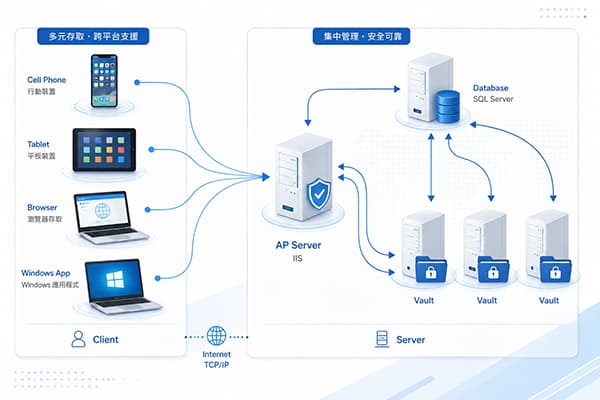
Traditional PDM Architecture vs. CIMer PDM System Architecture
| Comparison items | Traditional PDM architecture | CIMer PDM (Distributed Architecture) |
|---|---|---|
| Data storage | Single Server | Multi-node |
| Access speed | Accessing the internet from other locations via VPN results in slow speeds. | Local cache for extremely fast image loading. |
| Network load | High load can easily cause network congestion. | Low bandwidth requirements, automatic background synchronization |
| Collaboration skills | Limited to a single location, cross-border collaboration is difficult. | Supports simultaneous global design, production, and review. |
| Version risks | Transmission delays may cause version mismatches. | Mandatory copyright control and revision processes, consistent globally. |
CIMer System Core Architecture Description
1
AP Server (Application Server)
The core control layer features a relatively lightweight architecture. It includes user login, access control, workflow, BOM management, API integration, web management, project management, and search indexing.

2
Vault Server (data repository)
Independent Vaults can be configured for each location, allowing CAD files to be stored locally and synchronized to other locations. This results in fast map opening speeds, eliminates the need to access large files across borders, reduces VPN congestion, and enhances off-site backup capabilities.
3
Multi-CAD Integration
Directly embeds into CAD software, supporting: SolidWorks, Creo, NX, Inventor, CATIA, AutoCAD Solid Edge, IronCAD, etc.
4
Engineers can use it without interference.
You can perform Check In/Out, release, BOM creation, and revision without leaving the CAD screen, and link combined diagrams.
5
CIMer Web adopts Browser-based Web UI
It can perform functions such as viewing drawings, approving documents, approving workflows, and viewing Bill of Materials (BOM) without requiring CAD installation. It supports Android, iPhone, iPad, Mac, and Linux.
6
Lightweight Graphics Architecture
No need to send original CAD files; CAD files can be converted to 3D HTML/PDF, enabling fast international transmission, allowing customers to view drawings directly, and enabling paperless factory operations, reducing the risk of data leakage.