

- Home
- Products & Solutions
- PDM Product Data Management
- Distributed Data Management (PDM)
Distributed Data Management (PDM)
Distributed PDM is a PDM (Product Data Management) architecture that allows teams in multiple locations, across departments, or across countries to simultaneously manage product design data, BOMs, versions, processes, and permissions. It is particularly important in manufacturing, mechanical design, electronics R&D, and ODM/OEM collaboration.
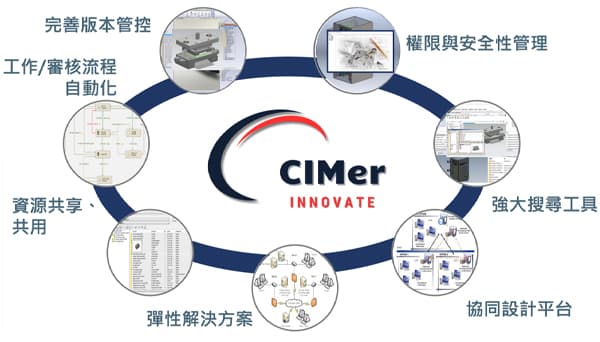
Traditional PDM Challenges and CIMer Distributed PDM
Core concepts:Compared to traditional single servers, distributed PDM...Multiple data nodes and local cacheThis solves the problems of slow access speed and VPN congestion when accessing large CAD files across borders.
| Traditional PDM | CIMer Distributed PDM |
|---|---|
| Single Headquarters Server | Multiple data nodes |
| All CAD/drawing documents are centrally managed. | Local pickup is available at each location. |
| slow access speed from other locations | Automatic version synchronization |
| It can easily cause VPN congestion. | Global Collaborative Design |
The key to implementing a distributed PDM, in addition to network architecture and CAD integration capabilities, is to establish access control, such as various permissions for R&D, manufacturing, outsourcing, and customers, to prevent data leakage.
1
Data synchronization across multiple locations (different regions)
CAD, drawings, images, audio/video files, BOM, ECO, specification documents

2
Local fast access to large CAD files
SolidWorks, Creo, Inventor, NX, CATIA, Solid Edge, Iron CAD
3
Version consistency control
To prevent Factory A from modifying an old version while Factory B uses the wrong version, or even the customer receiving outdated drawings, CIMer PDM can enforce version control, revision processes, and access locks.
4
Cross-border collaborative research and development to form a complete digital research and development chain
This type of company involves designing in Taiwan, prototyping in China, mass production in Vietnam, and finally providing the product to European and American clients for review and approval.
Key Values of Distributed PDM
Importing requires attention to network architecture (such as dedicated lines/CDN), CAD integration stability (such as file locking mechanisms), and granular access control. Ensure consistency of CAD, BOM, and ECO data across different locations, utilize a Cache Server to accelerate drawing development, reduce bandwidth load, enforce version control and access locking, and prevent production errors.

Automatic synchronization

Performance optimization

Strict control
Application areas of distributed PDM
It is particularly suitable for industries that require cross-border collaboration and frequently use CAD drawing tools such as SolidWorks, Creo, Inventor, NX, Solid Edge, and CATIA, such as machinery manufacturing, precision machining, bicycles, semiconductor equipment, automation equipment, electronics, and machine tools.
Consulting services