

- Home
- Products & Solutions
- Approval process management
CIMer Workflow Management
CIMer's "Workflow Management" is one of the core components of the entire PDM/PLM system. It's not just a typical email approval process, Excel workflow, or EIP form approval. Instead, it's a "product data-driven digital workflow platform" that integrates CAD, BOM, PDF, images, videos, Office documents, ECOs, projects, and ERP data into the workflow. It also establishes a notification center that connects with email servers, Line, WeChat, and other platforms based on customer needs.
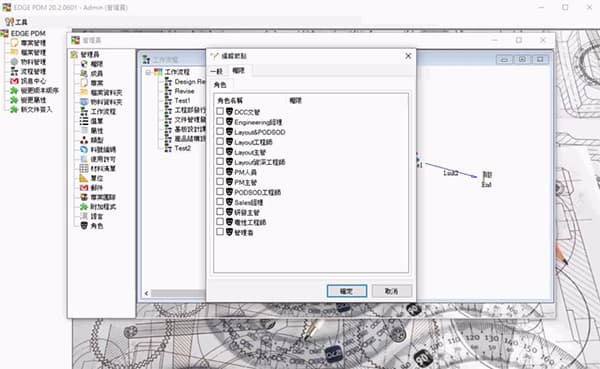
Traditional process approval vs. CIMer process approval
| Traditional approval process | CIMer Process Approval |
|---|---|
| Data disconnect: Often, when signing off on paper or through general BPM systems, the signatory looks at the forms but finds it difficult to immediately verify the accuracy of the corresponding CAD drawings or BOM. | Item binding: The approval form is directly linked to technical documents or CAD models, allowing reviewers to directly access the text and images on the same interface. |
| Manual updates: After approval, the file status needs to be manually modified (e.g., from "Under Design" to "Issued"), which can easily lead to omissions. | Automated Changes: Once approved, the system automatically changes file permissions and status, and synchronizes the updates to global nodes, ensuring that the production server always receives the latest version. |
| Communication gap: When changes occur, downstream units cannot be automatically notified; communication must rely on email or verbal communication. | Compliance and Traceability: Automatically retains a complete ECO/ECN history, allowing you to trace back at any time which version was approved by whom and when. |
By using CIMer's workflow approval process, design data such as CAD, BOM, office documents, PDFs, ECOs, audio and video files, and project data are generated and approved by the customizable Workflow Engine. This process is synchronized with ERP systems, achieving "workflow directly linked to product data." This is the biggest difference between CIMer and general BPM.
1
Drawing approval process
Engineers complete the drawings and submit them to their supervisors for review, then quality assurance confirms them before final release. After release, the system automatically updates the version, locks the file, and notifies relevant departments. This prevents unapproved drawings from leaking, factories from using the wrong version, and customers from receiving outdated versions.

2
ECO / ECN Change Process
This is one of the most important processes in manufacturing, such as: design changes, ECO establishment, supervisor approval, procurement confirmation, ERP synchronization, and formal implementation to form a complete "Engineering Change Management" process and track its history.
3
Document approval management
SOPs, ISO documents, customer specifications, test reports, quality documents, etc., form a "digital document process".
4
Conditional Workflow
For example: The monetary threshold is set at cost > 1 million, and the process is based on the BOM (Bill of Materials) requirements (including key components) and customer criteria (overseas OEM/English documentation review). The General Manager approves the application, followed by a countersignature from Quality Assurance. The process is highly customizable.
5
Web/Mobile Sign-off
Signers can sign via mobile phone, iPad, or browser without returning to their computer. The system also supports real-time reminders, a dashboard, and a notification center, and can be integrated with email servers, Line, WeChat, etc., according to customer needs.
6
Authorization and Audit
The system records the personnel, time, location, and circumstances of approvals, as well as modifications and process history. It complies with ISO 9001 audit requirements, customer verification, and cybersecurity needs.
Key Value of CIMer Workflow
The Workflow engine is very similar in logic to large-scale BPM systems. Workflow can be integrated with BOM, which is a significant advantage of CIMer. While typical BPM systems only process forms, CIMer directly handles product data, from BOM modification to Workflow initiation and final approval, and synchronizes with ERP to form a "digital product workflow".

EIP form approval

Dashboard for Battle Situation Management

Digital Process War Room

Digitalization of R&D processes
Workflow + ESG + Information Security
CIMer process approval management integrates multiple applications of general BPM.
The CIMer Workflow integrates BPM form processes, ERP approval processes for procurement/finance, and SharePoint document processes into CAD + BOM + ECO + project integration, and will also develop "AI Workflow" in the future. This will include AI process suggestions, AI bottleneck analysis, AI latency prediction, AI risk warnings, and AI document search mechanisms.
Consulting services